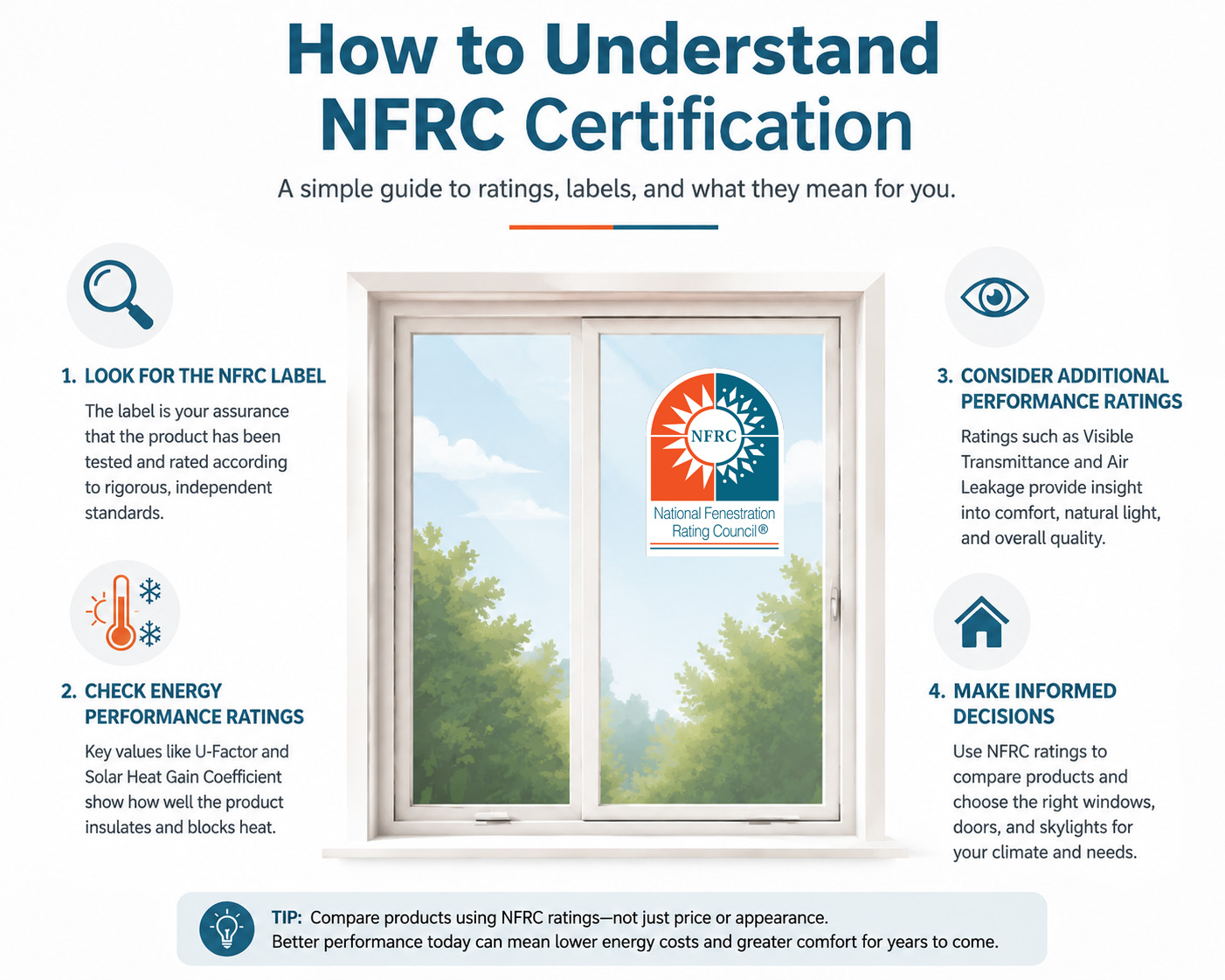
Summary: The NFRC label isn’t a wall of confusing numbers — it’s four data points you can use directly in a selection decision: U-Factor for insulation, SHGC for solar/heat control, VT for daylight, and AL for air sealing. Once you can read these four, you can quickly judge whether a window fits your climate and project.
1. What Is NFRC Certification?
NFRC (National Fenestration Rating Council) is an independent, nonprofit third-party body that tests, simulates, and labels the energy performance of windows, doors, and skylights. It exists to solve a very practical problem: before NFRC, manufacturers published their own “efficiency numbers” using inconsistent methods, making it hard for buyers to compare products fairly. NFRC standardized the testing procedure and the label format, so any two windows can be compared using the same set of numbers.
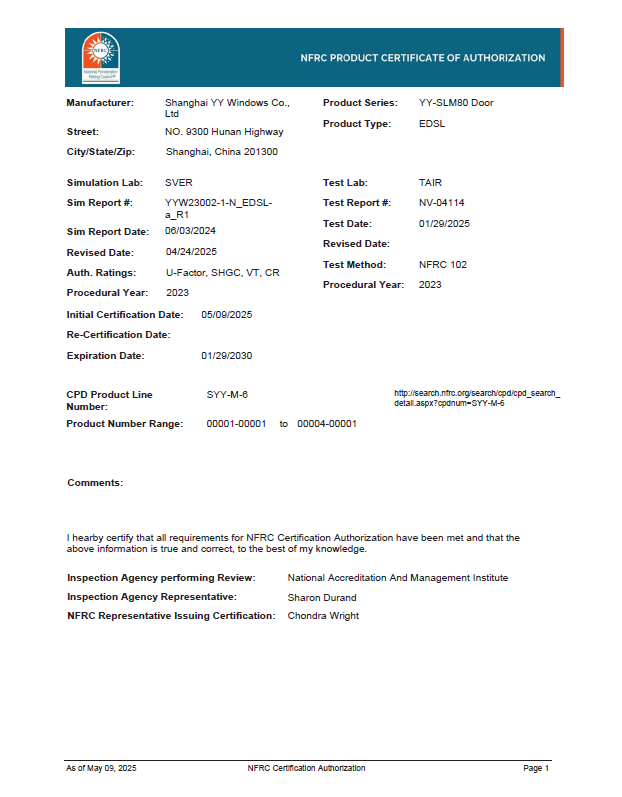
(NFRC For YY Product)
2. What Does the NFRC Label Look Like? A Section-by-Section Breakdown
A complete NFRC label is typically organized into a few clear blocks:
- Top: The NFRC logo and the word “Certified,” confirming the product has been rated through NFRC’s process.
- Middle-left: Manufacturer name, product line, product type (window, glass door, etc.), and a brief spec description.
- Middle-right: The four core performance numbers — U-Factor, Solar Heat Gain Coefficient (SHGC), and optionally Visible Transmittance and Air Leakage.
- Bottom: Certifying body information and, in many cases, applicable ENERGY STAR climate zone guidance.
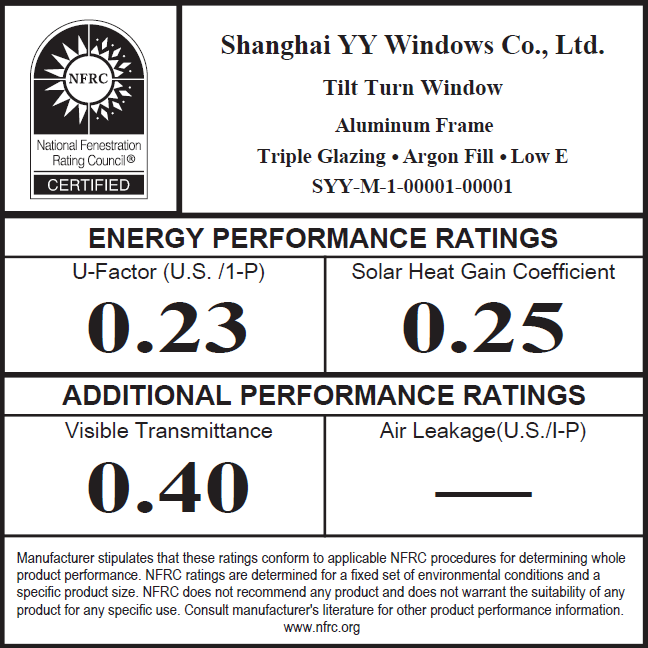
(YY product NFRC LABEL)
When you receive a label, it’s worth checking it in order: first confirm the product info matches what was actually purchased, then review the four performance numbers, and finally check whether a climate zone applicability note is included.
3. What Do the 4 Key Numbers Actually Mean?
U-Factor: Insulation — How Well It Keeps Heat In or Out
U-Factor measures how well a window resists heat transfer. The lower the number, the better the insulation — meaning less heat escapes in winter or enters in summer through conduction. Typical values range roughly from 0.20 to 1.20. Cold-climate buyers usually prioritize a low U-Factor to cut winter heat loss; in cooling-dominated climates like Florida, U-Factor still matters, but it’s typically a secondary consideration behind SHGC.
SHGC:Solar Heat Gain — How Much Sun Heat Gets In
SHGC measures the fraction of solar radiation that passes through a window and converts to heat indoors, on a scale of 0 to 1 — the lower the number, the better it blocks solar heat. In cooling-dominated climates like Florida, SHGC is often the number worth prioritizing over U-Factor, since it directly affects air-conditioning load and indoor comfort.
Visible Transmittance:Daylight — How Much Natural Light Comes Through
VT also ranges from 0 to 1 — the higher the number, the more visible light passes through and the brighter the room feels with natural daylight. Selection often involves a trade-off between daylighting and solar control: chasing a very high VT can come at the cost of a higher SHGC.
Air Leakage:Air Leakage — How Well the Window Seals
Air Leakage measures the amount of air infiltration per unit area — the lower the number, the tighter the seal, meaning less uncontrolled heat exchange between indoors and outdoors. Typical values fall roughly between 0.1 and 0.3, and this rating is optional on some labels rather than mandatory.
4. In Florida or Southern Climates, Which Number Should You Prioritize?
Florida is a cooling-dominated climate, with high heat, humidity, and strong solar exposure for most of the year. Under these conditions, SHGC is usually the number to prioritize — a lower SHGC means less solar heat entering the interior and a lighter load on the cooling system. U-Factor still matters, but it typically has less overall impact on energy use than SHGC in this climate. VT should be weighed separately against a project’s daylighting needs; it’s not worth sacrificing too much natural light purely to chase a lower SHGC.
Exact target ranges vary by project type, orientation, and glazing package — it’s best to check a product’s actual NFRC data against the project’s climate zone rather than relying on a single “ideal number” that applies everywhere.
5. What Are the Specific NFRC Value Requirements Across North America?
One clarification first: NFRC itself doesn’t set a “pass/fail” line — its job is to test and label the actual numbers. The specific U-Factor and SHGC thresholds come from the ENERGY STAR program and local energy codes, which use NFRC’s tested data to determine whether a product qualifies.
The U.S. ENERGY STAR program divides the country into four climate zones, each with different U-Factor and SHGC thresholds for windows (based on the current ENERGY STAR Version 7.0 criteria):
Climate Zone | U-Factor (lower is better) | SHGC | Example Coverage |
Northern | ≤ 0.22 | ≥ 0.17 minimum (an equivalent-energy path also allows a higher U-Factor paired with a higher SHGC) | Great Lakes, Northeast, northern Midwest |
North-Central | ≤ 0.25 | ≤ 0.40 | Most of the Midwest, parts of the Mid-Atlantic |
South-Central | ≤ 0.28 | ≤ 0.23 | Texas, Oklahoma, and other south-central states |
Southern | ≤ 0.32 | ≤ 0.23 | Florida, Gulf Coast, and other southern states |
Notice that Florida’s Southern zone has the same strict SHGC requirement (≤0.23) as South-Central, but a noticeably more relaxed U-Factor threshold (≤0.32). This confirms the point made in Section 4: for Florida selections, SHGC is usually the number worth checking first.
For projects covering the Canadian market, keep in mind Canada commonly uses ER (Energy Rating) — a combined score that folds U-Factor, SHGC, and air tightness into a single number, where higher is better. This works differently from the U.S. approach of evaluating U-Factor and SHGC separately, so it needs to be confirmed independently during selection.
These thresholds shift as ENERGY STAR versions update (they’ve tightened progressively from Version 5.0/6.0 to the current Version 7.0), so it’s best to verify a product’s currently valid NFRC data before project submittal rather than relying on a fixed number from a prior year.
FAQ
Q: Are residential and commercial NFRC certifications the same?
A: Not exactly. NFRC runs separate Residential and Commercial certification programs. Both evaluate the same core metrics (U-Factor, SHGC, VT, air leakage), but commercial projects typically use project-specific Label Certificates tied to a building address, rather than the standard label affixed to a residential unit.
Q: Is a lower VT always better, like U-Factor and SHGC?
A: No. Visible Transmittance works the opposite way — a higher VT means more visible light passes through and more natural daylight indoors. Selection usually involves balancing daylighting against solar control (SHGC), not maximizing or minimizing VT on its own.
Q: Do building code officials actually rely on the NFRC label for compliance?
A: Yes. Many jurisdictions accept the U-Factor, SHGC, VT, and air leakage data on an NFRC label or certificate as the basis for energy-code compliance review, which is why project submittals typically need to include the full NFRC documentation.